The Lyrai journal
How to Write a Poem: A Step-by-Step Guide for Beginners
Learn to write your first poem with simple steps, original examples, and practical revision tips, even if you've never written poetry before.
You don't need to know complicated literary terms or make every line rhyme to write a poem. You need something you want to express and a willingness to pay attention to the words you choose. If you're wondering how to write a poem for the first time, this guide will take you from a small idea to a finished draft.
1. Start with one feeling, memory, or question
Trying to write about *love*, *life*, or *sadness* all at once can make your poem feel vague. Start smaller: the sound of a familiar voice, an empty chair at dinner, or the moment the rain stops.
Ask yourself:
- What happened, or what do I wish had happened?
- What detail do I remember most clearly?
- What feeling do I want someone else to recognize?
For example, rather than choosing “missing someone,” choose “I still set two cups on the table.” That single action gives the emotion a place to live.
2. Collect concrete details before writing lines
Spend two minutes listing things you could see, hear, touch, or smell in your scene. Don't worry about making them poetic yet.
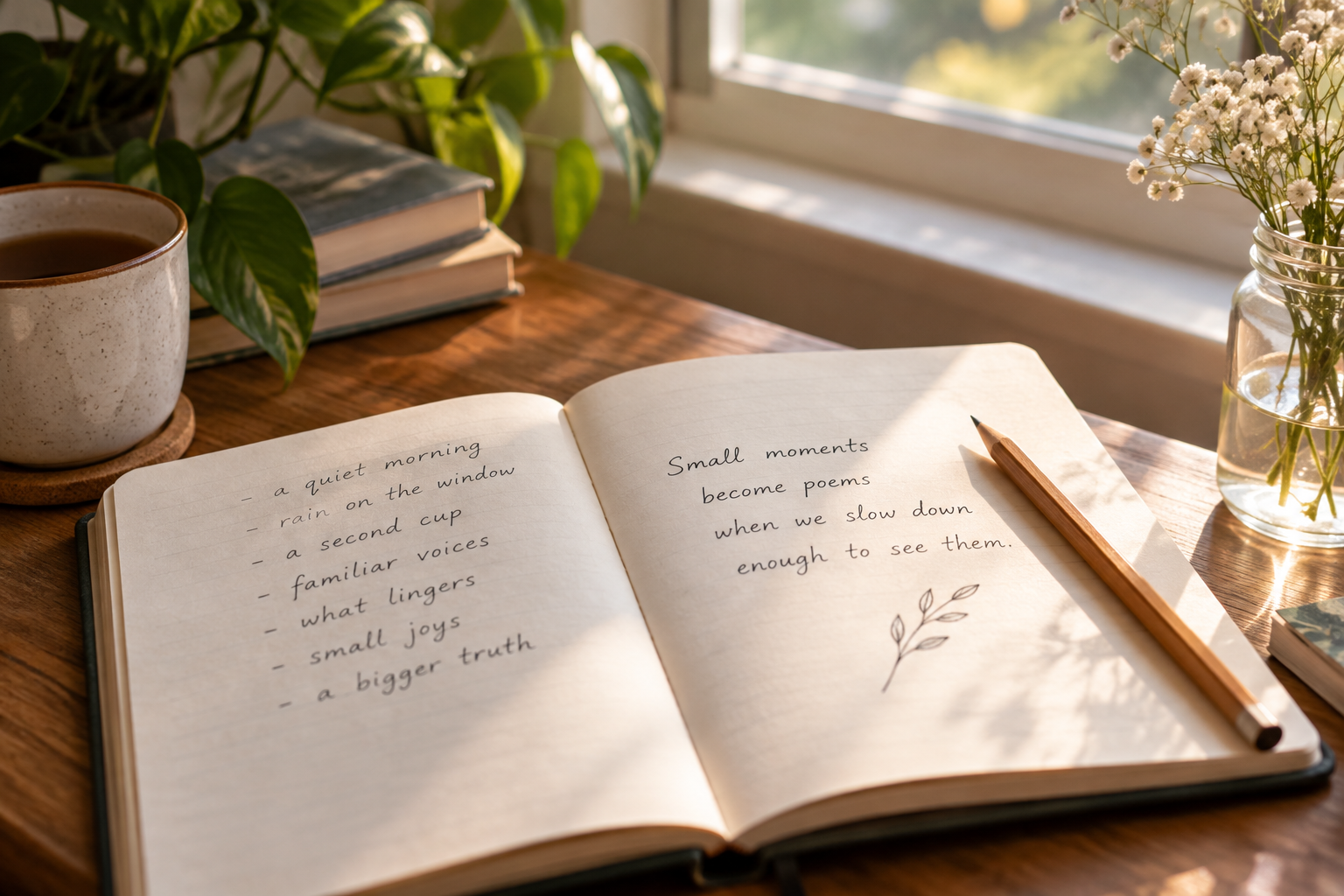
Example notes: cold tea, kitchen light, a second cup, a quiet morning, rain on the window.
Specific details help the reader imagine what you felt. “I am lonely” tells us the feeling; “The second cup is still clean” lets us discover it.
3. Write a first line that opens a door
Your opening doesn't need to explain everything. It can begin with an image, an action, or a surprising observation.
Compare:
I feel sad because you are gone.
With:
I still make room for your cup.
The second line suggests a story without spelling it out. Try writing three different opening lines and choosing the one that feels most natural.
4. Build a short first draft
Write four to eight lines without stopping to correct every word. Follow your first image and see where it leads.
Original example:
I still make room for your cup,
beside the window in the rain.
The kettle sings to no one now;
the morning answers just the same.
This is only a draft. It has an image, a mood, and a simple movement from habit to absence. You can change anything later.
5. Decide whether your poem needs rhyme
A poem doesn't have to rhyme. In free verse, you can focus on images, pauses, repetition, and the sound of your words instead of following a fixed rhyme scheme.
If rhyme helps your idea, use it. If it forces you to write something unnatural, leave it out. Read both versions aloud and listen for the one that carries the feeling better.
6. Use line breaks to guide the reader
Where a line ends affects rhythm and emphasis. You can slow the reader down by placing an important word at the end of a line, or create movement by carrying a thought into the next.
For example:
I kept your name
in the space between two breaths.
Try moving the break after “space” and reading both versions aloud. There is no universal right answer. Choose the rhythm that serves your meaning.
7. Revise without losing your own voice
The first draft captures an idea. Revision helps the idea reach someone else. Look for three things:
1. Vague words: Can “beautiful,” “sad,” or “nice” become a specific detail? 2. Unnecessary explanations: Does an image already express what the next line repeats? 3. Awkward rhythm: Is there a phrase you stumble over when reading aloud?
Here's one possible revision of our example:
Before:
The kettle sings to no one now;
the morning answers just the same.
After:
The kettle hums into the rain.
No one reaches for the other cup.
The revision is not automatically better for every reader. It's quieter and more concrete, while the original has a stronger musical quality. Keep the version that sounds like *you*.
If you want help spotting awkward phrasing or exploring alternative words, Lyrai can support your revision process. Use its suggestions as options rather than letting a tool decide what your poem should mean.
8. Give your poem a title
You can choose a title before writing, but waiting until the end often works better. Look for an image, a contrast, or a small detail that anchors the poem. Our example could be called “The Other Cup.” A title doesn't need to summarize the entire poem.
9. Try this five-minute poetry exercise
Set a timer for five minutes and follow these steps:
1. Pick one ordinary object near you. 2. Connect it to a memory or emotion. 3. Write five sensory details. 4. Turn two details into four short lines. 5. Read your poem aloud and change one word that doesn't fit.
Writing prompt: *Write about a goodbye without using the words “goodbye,” “sad,” or “miss.”* Constraints like these can push you toward more original images.
Common beginner mistakes
- Chasing impressive words: Clear language is often more affecting than complicated vocabulary.
- Forcing every line to rhyme: Rhyme is a choice, not a requirement.
- Explaining every emotion: Give readers room to feel something themselves.
- Editing before finishing: Let the first draft exist before judging it.
- Comparing your first attempt to published poets: Learning to notice and revise is part of writing.
Frequently asked questions
How long should a beginner's poem be?
As long as the idea needs. Four honest lines can work better than twenty that repeat the same thought. Start short and expand only when something new needs to be said.
Can I write a poem without rhyming?
Yes. Free verse uses line breaks, imagery, sound, and rhythm without requiring end rhymes.
How do I know if my poem is finished?
Read it aloud, check that each line contributes something, and put it aside for a day if possible. A poem may be ready when further changes make it different but not clearer.
Your first poem starts with one detail
You don't have to sound like anyone else. Start with something you noticed, write a few imperfect lines, and return to them with curiosity. When you're ready to refine a word or improve a line while keeping your intention, explore the writing tools in Lyrai. The poem remains yours.
Your turn to put down a few words.
Try it free